
The deficit stood over Rs 8 trillion in the first seven months of the current financial year. Non-tax revenues, comprising transfers from the RBI and dividends of the public sector units, shored up the Centre's revenues.
In recent years, excise duty collections had always played truant to the expectations.

The challenge of achieving fiscal deficit targets for the next two years seems daunting.

Neither films were rejected by the audience, something that has happened with so many recent, mid-budget films.

The government on Saturday allocated Rs 2826.92 crore to the sports budget for the next financial year, which is up by a mere Rs 50 crore from the revised estimates of 2019-20. The government gave a substantial hike of Rs 291.42 crore to its flagship Khelo India programme for development of sports at the grassroot and youth level, which meant that most of the other heads got reduced allocation in an Olympic year.

The Union Government's fiscal deficit remained above the annual target for second month in row at the end of August, mainly on account of the impact of lockdown on revenue collections. According to the data released by the Controller General of Accounts (CGA), fiscal deficit during April-August was at 109.3 per cent of the annual target estimated in the Budget.

Finance Minister Nirmala Sitharaman on Friday pitched for front loading of capital expenditure, saying it is critical for revitalisting the economy post the coronavirus pandemic. During a virtual meeting with senior government officials to discuss the infrastructure roadmap ahead, she also asked ministries to aim to achieve more than their capital expenditure (capex) targets. The Union Budget 2021-22 provided a capital outlay of Rs.5.54 lakh crore, a sharp increase of 34.5 per cent over the Budget Estimate of 2020-21.

'The Budget numbers presented severely underestimate the magnitude of the unstated fiscal crisis that we went through in 2018-2019, which cannot be conceivably be fully reversed in 2019-2020,' points out Rathin Roy, director, National Institute of Public Finance and Policy.

Do the actual numbers bear out the claims made by the government or do they suggest something else? asks A K Bhattacharya.

The amount allocated for 2019-20 is 11 per cent higher compared to Rs 55,000 crore allocated for the year 2018-19.

IThe fiscal deficit target for 2020-2021 was originally set at 3.5 per cent of GDP. But the government's revenues have collapsed and its expenditure burden will only increase over the Budget estimates.' With the government having already planned for an additional borrowing of over Rs 4 trillion, the fiscal deficit for the current year would be much higher than the Budget estimate, notes A K Bhattacharya.

"The Union Budget represents the aspirations of 130 crore Indians and lays out the path towards India's development. I invite you all to share your ideas and suggestions for this year's Budget on MyGov," the PM said according to a statement posted on his official website on Thursday.

The government also proposed promoting 'one product one district' for better marketing and export of horticulture crops. It also called on states for early implementation of three key central model laws on land leasing, agriculture produce and livestock marketing and contract farming.
The economy may grow by around 7 per cent this financial year as estimated by the Monetary Policy Committee (MPC) of the Reserve Bank of India (RBI), say economists with various organisations. The first advance estimates for 2023-24 will be released on Friday by the National Statistical Organisation (NSO), an exercise done for calculating ratios such as the fiscal deficit. The interim Budget will be presented on February 1.
After remaining in the positive zone for three months, India's exports contracted 1.2 per cent to $33.98 billion in July, while the trade deficit widened to $23.5 billion.

After the Covid-19 pandemic that derailed the economy since 2019, the Durga Puja festival in West Bengal is back with an estimated 20-30 per cent jump in festive spending. Retail sector is the key contributor to the state's Durga Puja economy which was Rs 32,377 crore in 2019, according to a British Council study conducted for the state government. Retail accounts for 85 per cent of the total puja economy and the rest is shared among pandal making, decoration, illumination, entertainment, advertisement, food & beverage and others.
Railway Minister Lalu Prasad on Friday presented a populist interim Railway Budget in Parliament on Friday. Following is the entire speech of the railway minister:

Sliding for the fifth straight session, the rupee fell 3 paise to close at a fresh lifetime low of 79.06 against the US dollar on Thursday amid a strong greenback overseas and unrelenting foreign fund outflows. At the interbank forex market, the local unit opened at 78.92 against the greenback and witnessed an intra-day high of 78.90 and a low of 79.07. It finally settled at 79.06, down 3 paise over its previous close of 79.03.

'China's opaque defence allocation processes are shrouded in mystery and have triggered security dilemmas among its neighbours and others,' notes China expert Srikanth Kondapalli.
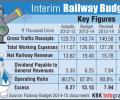
Anticipating healthier economic growth, the Railways has targeted a record Rs 1.6 lakh crore in revenue for the next financial year, while no increase has been proposed in passenger fares and freight rates.

Expressing commitment to augment the country's infrastructure, Finance Minister Nirmala Sitharaman on Monday proposed to significantly enhance capital expenditure to Rs 5.54 lakh crore in the next fiscal, besides creating institutional structures and giving a big thrust to monetizing assets to achieve the goals of the National Infrastructure Pipeline (NIP). Sitharaman said NIP, that was launched in December 2019 with 6,835 projects, has now been expanded to 7,400 projects and around 217 projects worth Rs 1.10 lakh crore under some key infrastructure ministries have been completed. "For 2021-22, I propose a sharp increase in capital expenditure and thus have provided Rs 5.54 lakh crores which is 34.5% more than the BE of 2020-21," the finance minister said.
Several questions arise on the appropriateness of the measure in the already strained fiscal scenario, says M Govinda Rao.

'I do not believe that you would have a booming economy when you go into elections if you had a budget which did not answer the fiscal deficit concerns.'
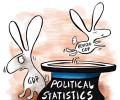
The Economic Survey 2022-23 (FY23), to be presented a day before Union Budget 2023-24 (FY24), is likely to project India's real gross domestic product (GDP) growth between 6 per cent and 7 per cent for FY24, Business Standard has learnt. The broader theme of the Survey could be on how India has dealt with two years of a global pandemic and the ongoing geopolitical disturbance, the strengths and weaknesses that emerged, and what lessons may be learnt. The much-awaited Survey will be the first one by Chief Economic Advisor V Anantha Nageswaran and his team in the finance ministry's economic division.

West Bengal is home to 43,000 Durga Pujas, and the business around it is a major economic driver.

This will encompass the sale of Air India, a number of other privatisation initiatives, mergers, initial public offerings, the Centre's two exchange-traded funds, buybacks and offers-for-sale, and even monetisation of land assets.
The Union Budget for 2017 is likely to be presented on February 1. An approval for merging the Railway Budget with the General Budget was accorded by Finance Minister Arun Jaitley on Monday.

A combination of factors, including heavy investments in US Treasury bonds and dollar sales at a healthy profit, facilitated the Indian central bank in transferring a record surplus of Rs 2.11 trillion to the government for 2023-24 (FY24). The RBI's dollar purchases increased in FY24, supported by robust capital inflows endorsing the economy's health.
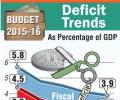
Finance Minister Arun Jaitley presented the Budget today.

For example, railways, roads and highways, and shipping could form a section within the Budget as an omnibus transport sector

According to the figures released on October 31, the deficit till September had inched down to 65.6 per cent of the budget estimate for 2012-13, compared with 65.7 per cent till August.

Against FY17 target of Rs 56,500 cr, Centre plans to fetch around Rs 6,400 cr in the first half.

If the government cuts wasteful expenditure as it is trying now, the deficit would at most fall to 8 per cent, not less than that.

The government had set the direct tax collection target of Rs 3.70 lakh crore (Rs 3.7 trillion) in the budget for 2009-10, which was later revised upwards to Rs 3.87 lakh crore (Rs 3.87 trillion).
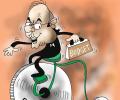
There was no law that prevented the government from presenting a sixth full Budget, or something similar to it.

In absolute terms, revenue receipts stood at Rs 9.07 lakh crore at the end of October. For the entire 2019-20, the revenue receipts have been pegged at Rs 19.62 lakh crore.

Rural outlay may go up 23% to reduce pains of demonetisation

The government has exhausted only 39 per cent of its fiscal deficit target in the first half of FY24.

HDFC was the top gainer in the Sensex pack, climbing nearly 4 per cent, followed by PowerGrid, Sun Pharma, Tata Steel, Tech Mahindra and Bajaj Finserv. NSE Nifty surged 234.75 points to 17,401.65.
